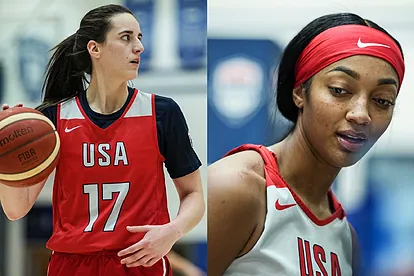
Caitlin Clark and Angel Reese from the April 1–3, 2026…
As the international basketball calendar heats up, the release of the USA Basketball Women’s National Team training camp roster often serves as a definitive statement on the program’s hierarchy. This week, the absence of two of the game’s most transcendent young stars Caitlin Clark and Angel Reese from the April 1–3, 2026, training camp has ignited a firestorm of debate across social media. However, a closer look at the program’s philosophy reveals that their exclusion isn’t a snub; it is a calculated adherence to a “veteran-first” culture that has defined American dominance for decades.
The Missing Duo: A Brief Absence?
Both Clark and Reese have been integral to the recent explosion of interest in women’s basketball. Their rivalry, which began in the 2023 NCAA Championship, transitioned seamlessly into the professional ranks, where they have continued to shatter viewership and attendance records. Interestingly, both were included in the Team USA pool for the FIBA World Cup qualifiers earlier this February, which made their omission from this specific short-term evaluation window even more jarring to the casual fan.
Sources close to the selection process suggest that availability and health played a role. Clark, who missed a significant portion of the 2025 WNBA season with a persistent groin injury, is reportedly focusing on a full recovery before the high-intensity summer schedule. Reese, while healthy, is navigating a roster selection process that prioritizes seasoned interior players who have already mastered the physical, international style of play.
The “Seniority” Standard
USA Basketball does not merely collect the most popular players; it builds a cohesive machine. The current camp roster remains anchored by “gold-standard” veterans like Breanna Stewart, A’ja Wilson, and Napheesa Collier. These players represent a lineage of success that includes ten Olympic gold medals.
For the selection committee, the primary hurdle for Clark and Reese is Senior National Team experience. While both have decorated resumes in junior international competitions (U16, U19), the leap to the Senior level requires a specific familiarity with FIBA’s physical officiating and the tactical demands of Coach Kara Lawson’s system.
“To put a player on that team without the requisite senior experience could be a disservice to the player and the process,” noted one analyst. “The Olympics and World Cups are not for development; they are for execution.”
A Program Beyond One Generation
The exclusion of the “Big Two” underscores a fundamental truth: Team USA does not rely on a single generation. While the “Clark Effect” has undeniably grown the game’s commercial footprint, the national team’s internal engine is fueled by a deep well of talent that spans multiple eras.
The program successfully bridges the gap between the legendary leadership of the past and the rising stars of tomorrow like Paige Bueckers and JuJu Watkins, who have also seen varying levels of involvement in recent camps. By maintaining a strict meritocracy based on international longevity rather than domestic stardom, Team USA ensures that when Clark and Reese eventually do take the floor in the red, white, and blue, they will have earned it through the same rigorous pipeline as the icons before them.
For now, the message from Colorado Springs is clear: the future is bright, but the present still belongs to the veterans.