A Rare Photo Hid One of Randy Rhoads’ M… Read more 👇👇
Ozzy Osbourne realized he had struck gold when he brought Randy Rhoads on board as his guitarist in late 1979. A true virtuoso, Rhoads dazzled with two-handed tapping, complex scale runs, and dramatic whammy-bar dive bombs techniques that gave Ozzy’s early solo records the explosive guitar work heavy metal demanded in the early 1980s.
However, Rhoads’ extraordinary dedication came with a downside for Osbourne, the former Black Sabbath frontman who died on July 22. Randy practiced almost nonstop, even during late hours on tour, a habit that often drove Ozzy to frustration.
In early 1982 the final year of Rhoads’ life a solution arrived in the form of a custom-built practice pedalboard. Designed specifically for him by Jon Graves and Domenic Turlace of Zeus Audio Systems in Alhambra, California, the compact board was meant strictly for quiet practice. Zeus Audio was known for its guitar pedals and small practice amps, and Rhoads received the pedalboard on New Year’s Eve 1981, about two months into the tour supporting Diary of a Madman, Ozzy’s second solo album.
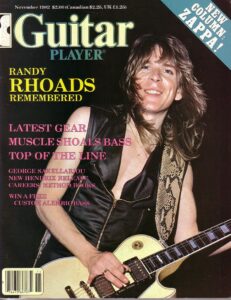
Guitar Player readers caught their first and likely only glimpse of the pedalboard in a photograph by Neil Zlozower published in the magazine’s November 1982 tribute issue to Rhoads. Spanning two pages, the image showed Randy practicing on a couch beside three of his electric guitars: a 1974 Gibson Les Paul Custom, a Jackson Concorde, and a Karl Sandoval Custom Polka Dot Flying V. On the floor in front of him sat the small pedalboard, its components mostly hidden from view.
Two months after the photo appeared, Graves and Turlace подробно explained the setup in Guitar Player’s January 1983 issue, responding to a reader’s inquiry. Despite its modest size, the board featured a Boss Dr. Rhythm drum machine, three MXR pedals a 6-Band Graphic Equalizer, a Commande Time Delay, and a Micro Chorus and a Zeus 8401 Mini Amp. The red 8401, roughly brick-sized, included controls for preamp, volume, and tone, along with preamp and external speaker outputs. An additional amp with a 4½-inch speaker was supplied specifically for the drum machine.
To keep Ozzy from being driven crazy by constant rehearsal, the pedalboard also included a special addition. “One unique feature is the ‘Ozzy Jacks,’ added at Ozzy Osbourne’s request,” Turlace told Guitar Player. “They allow separate headphone signals from the guitar amp and rhythm machine while muting the main speaker.”